
Sharing Best Practices: Hourglass Podcast (Transcript)
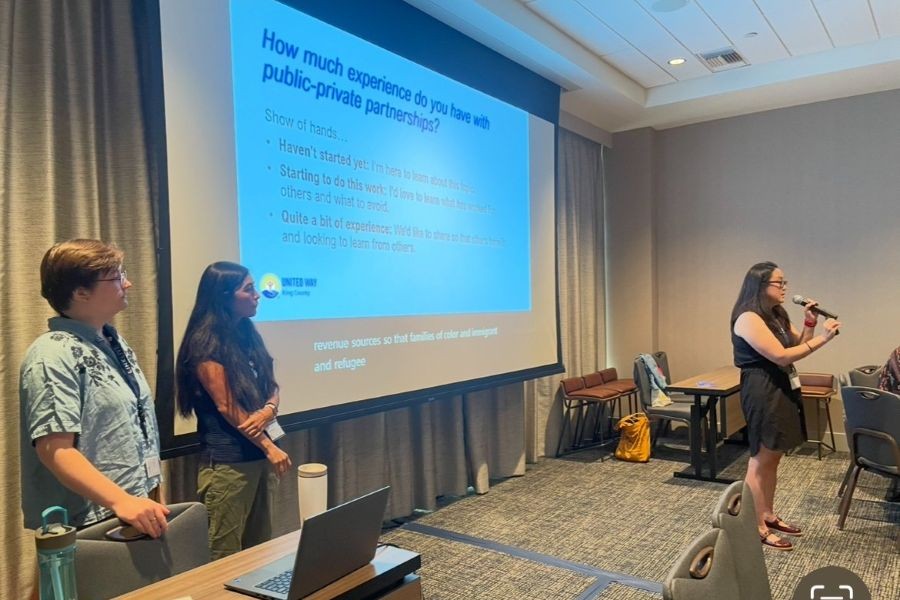
Good news happens. United Way of King County joined more than 350 attendees from other United Way agencies at the West Regional Conference in Portland, OR.
Members of United Way of King County staff led discussions on many facets of our work, including our public-private partnerships that generate resources and support for community-based organizations running early learning programs.
For this week’s episode, we sat down with our education strategies director, Joy Sebe, and community impact manager, Holly Lackey, for a conversation on topics including the importance of sharing best practices with like-minded organizations and ways we’ve built trust across sectors through our public/private partnerships.
We will also discuss our Community Partnership Kit Offerings and an upcoming volunteer opportunity at United Way supported by grantee El Centro de la Raza.
Transcript
Joy Sebe 0:00
We at United Way often are operating as a connective tissue that’s connecting sectors and organizations together that don’t normally work together. So that can include the private sector, such as corporations. It can include the nonprofit sector, public funders. It can also even include fields of work like food, housing, and education.
Joe Burris 0:27
This is Hourglass, the podcast for United Way of King County in Seattle. Up next, sharing best practices. Last month, United Way of King County joined more than 350 attendees from other United Way agencies at the West Regional Conference in Portland, Oregon. Members of United Way of King County staff led discussions on many facets of our work, including our public-private partnerships that generate resources and support for community-based organizations that run early learning programs. For this week’s episode, we sat down with our Education Strategies Director, Joy Sebe, and Community Impact Manager, Holly Lackey, for a conversation on topics including the importance of sharing best practices with like-minded organizations and ways we’ve built trust across sectors through our public-private partnerships. We will also discuss our community partnership kit offerings and an upcoming volunteer opportunity with United Way-supported grantee El Centro de la Raza. I’m your host, Joe Burris. Thanks for tuning in.
Joy Sebe 1:40
Public-private funding partnership: Right, we have three funders working together. We have United Way of King County, the private funder, our engagement team, our fundraising team. Shout out to you all. Are actively, actively fundraising for this program to get those private dollars out the door. At the same time, we are receiving grants from our city government and our county government. In this case, City of Seattle and King County. We’re pulling all that money together and then getting it out to contracts to, in this case, 13 grantee organizations.
Joe Burris 2:23
Have you ever been part of a group discussion where certain words or phrases were shared but not explained, and you wondered whether you were the only person in the group who didn’t know what they meant? United Way of King County is part of a collection of 1100 agencies across 30 countries and territories that comprise United Way Worldwide. These agencies impact the lives of about 48 million people annually. United Way Worldwide says, in areas including financial security and community resiliency, it’s not surprising that organizations in the same jurisdictions or regions are working on similar issues, and sometimes they take advantage of opportunities to gather and share best practices while learning from one another. That was the impetus behind last month’s United Way Western Regional Conference in Portland, Oregon. The regional conference attracted more than 350 attendees from 90 United Ways across 15 states for three days of sessions on fundraising strategies, program development, community impact, staff engagement, and marketing communications. Sharing best practices with like-minded individuals means that as groups, we often create spaces where it’s comfortable to say “I don’t know” or “I don’t understand.” It means we’re eager to explain terms, phrases, and concepts that most folks in our field hear quite often, but might not fully grasp. And with that, United Way Education Strategies Director Joy Sebe did a great job of explaining the term public-private partnerships during the conference. You just heard part of that engaging presentation. Joy, United Way Early Learning Impact Manager Whitney Nakamura, and our Community Impact Manager Holly Lackey led a breakout session titled “Leveraging public-private partnerships to provide stable support to immigrant families.” The session also demonstrated how United Ways can use such partnerships to stabilize funding for communities. The three led a PowerPoint presentation that began with the question, “How much experience do you have with public-private partnerships? It also delved into United Way’s history of partnerships between public, private, and community sectors, particularly as it relates to our early learning work through pooling public and private funds. United Way supports 13 or. Organizations that implement Parent-Child Plus, a national program that prepares kiddos for kindergarten with an in-home one-on-one teaching model, matching toddlers and parents with home visitors. Whitney emphasized the importance of relationship and trust building with families, providers, donors, and public funding partners. Holly shared that United Way of King County is uniquely positioned to advocate for community solutions across systems, including with local government partners.
Holly Lackey 5:34
A public entity, so we can advocate for things that our city and county partners may not be able to share or save, so that is a really important piece of this. Joy mentioned the FEP levy earlier, Family Education Preschool Promise, and so with that, we did gather grantees or sites, who, you know, let them know about this advocacy opportunity. We talked with them about their priorities. Centered that in the conversation, we have you know, Whit attended some public hearings on that. We had several sites testify at those public hearings, which we really appreciate and don’t take for granted the amount of trust that that takes from sites to be in those public spaces, particularly as organizations serving immigrant refugee populations in this moment.
Joe Burris 6:40
Parent Child Plus has leveraged robust data on both year-to-year and long-term educational outcomes to demonstrate the impact of the successful home visiting program. After our presentation on public-private partnerships, Joy Sullivan, the President and CEO of United Way of Larimer County in Fort Collins, Colorado, praised United Way of King County for our investment in early learning.
Joy Sullivan 7:07
I just so appreciate how United Way King County has invested so much in early learning, and particularly with this important group of community members. And I think it’s a testament to taking risks in those first 1000 days of life, or however many, and really challenging all of the eggs that we put in the downstream impacts of the lack of access to early opportunities, and you guys are showing what happens when you take that risk and go all in on kids and families at these early years.
Joe Burris 7:44
And Joey Holland, the 211 contact center director of the Inland Southern California United Way in Riverside, lauded our efforts to secure funding at the city and county levels for Parent Child Plus,
Joey Holland 7:58
and also just how you focus more so on fostering the workers that are in place, the program that’s in place, and maybe not so much focus on expansion, but just retention, because it’s a phenomenal program. I know one of the things that we were taking away, at least that might be beneficial for other states, other locations, is maybe looking at a cost benefit analysis in addition to the other impacts that you track, because I think for California or maybe other states to implement something of this nature, if we knew like okay, costs from kindergarten to graduation this set amount and the financial benefit for the city, so by financial benefits for the county and also on a national level level, that would just give us another way to approach our cities, our counties for potential funding for something similar in our own communities, but super impressive. Thank you,
Joe Burris 8:50
Joy, Whitney, and Holly were not the only United Way of King County staffers conveying our work and expertise at the conference. United Way IT project manager Sophia Austin took part in two panel presentations. The first was a mini breakout session entitled “A Framework for United Ways to Leverage Automation and AI.” The second was a plenary session entitled “Leading Innovation and Transformation in a Complex World.” Closing out the conference was a breakout session from local programs to statewide change, scaling food and tax access, that featured Sara Selemeyer, United Way’s director for ending hunger; Elsa Young, United Way food security impact manager; and Ryan McFarren, United Way senior manager for tax credits and financial stability. After the conference, Hourglass sat down with Joy and Holly for a conversation on topics including the importance of sharing best practices with like-minded organizations and ways we’ve built trust across sectors through our public-private partnerships. We begin with. Joy, who offered takeaways from the Portland conference.
Joy Sebe 10:04
This particular conference in Portland was focused around gathering the United Ways that are on the western side of the country, who often have kind of shared experiences, shared political environments, but it’s always such a value add to be part of this network because often in this political environment and kind of in the way that our country operates, it’s really easy to be polarized and to think of an us and them. And then, whenever I kind of go back to the United Way network, it really gives me kind of a a human reality check for our friends who are operating United Ways and serving communities throughout the country in regions that have very different cultural norms and expectations, and it’s it’s just so helpful to have to be grounded in that broader network. And so, the Portland Conference in particular, we talked a lot about our innovative work at United Way of King County. We really benefit from strong partnerships and support and funding partnerships across the county, private and public, and so Holly and I and Whitney Nakamura, another community impact manager, talked about, in particular, the ability for us to leverage public funds to provide stable support for immigrant and refugee families during this time.
Joe Burris 11:41
I was there for that session, and I was just amazed at how you all make something that might be complicated or complex for folks really simple and straightforward and easy to understand. Particularly those who may be familiar with the term public-private partnership, but may not know what it really means, right? So, can you delve into your discussion about public-private partnerships, and namely, what do they mean, and how does United Way employ them in our early learning programmatic work?
Joy Sebe 12:18
Yeah, it’s a great question. I think often in our nonprofit space, and often in like specialized spaces, we throw these words around. And public-private partnerships is one that gets thrown around without often a definition. And so, in the context of that presentation, in this particular early learning investment, and in United Way’s work, we’re specifically talking about public and private funding partnerships. So that’s funding that’s coming in from a public funder. In this case, our good friends at City of Seattle and our good friends at King County Best Starts for Kids, and then also from privately fundraised dollars, including from a generous network of individual donors, our friends over at Northcliffe Foundation, PNC Bank, Stolte Family Foundation, that has had a long partnership, and so it’s really how are we bringing together public and private funding to amplify community impact and do the best good out out in areas that really can benefit from and need it most.
Joe Burris 13:29
And also, we talked a little bit about the role of conveners. United Way has really been in that convener space. We’ve been in a lot of spaces through the years, but we really are in that convener space right now. And again, for those that may not know what a convener is, what a convener does, again, you really did a great job of explaining not only that, but our role as a convener. So, for our listeners, can you discuss the role of conveners in our work, and how does United Way serve as a convener?
Joy Sebe 14:04
Yeah, absolutely. So we at United Way often are operating as a connective tissue that’s connecting sectors and organizations together that don’t normally work together. So that can include the private sector, such as corporations, it can include the nonprofit sector, public funders. It can also even include fields of work like food, housing, and education. Right? So we’re we’re operating in all of those spaces simultaneously, and then have a lot of specialized expertise, both broad bird’s eye view and then really deep, deep levels of expertise. And so what we’re doing is, we’re kind of scanning the landscape and arena, and then assessing what gaps need to be filled. And then, who is best positioned to help fill those gaps? Whether it’s donations of diapers, or donations of books, or public dollars, or volunteer services and volunteer hours. And so, often as convener, we play this really critical role in also supporting our grantees in our organizations, so that there’s a really healthy and vibrant and sustainable ecosystem of grantees and nonprofits that are doing this work alongside us. So that looks like capacity building, it looks like providing support so that data quality is high, and so that we can kind of track how well we’re doing and making sure that the dollars we’re getting out into the community are making the most impact. It also means telling the story, telling the story of community and giving community platform to tell the story. And so Holly Lackey, who’s sitting with me here today, has been a really pivotal voice in making sure that at a time when there’s a lot of safety concerns for immigrant and refugee communities, that we’re helping people tell the story in a way that feels safe, as safe as possible, and kind of respectful of of their authentic kind of story. So, Holly, if you want to share a little bit about that:
Holly Lackey 16:35
Yeah, for sure. I think as we talk about storytelling and sharing stories, our team and United Way as a whole. I know we’ve put a lot of work and thought into making sure that stories are shared with respect, trust, and consent. Particularly right now, where privacy is a really big concern, and also and that includes recognizing when folks do want to be named in stories, and when that is really important, and making sure that that our grantees are their privacy is being protected when they do not want to be named for safety concerns, and that’s an incredible amount of trust that we have been working to build, and will continue to work to build, of course, and really are holding central to our work.
Joy Sebe 17:34
Yeah, and I absolutely agree with what Holly’s saying is that there’s a tremendous amount of integrity that is a key part of our storytelling in partnership with community. I think in that way, United Way is kind of, again, operating as that connective tissue that’s ensuring that the funding and money is going out to community, while also bringing people on board in terms of educating them about the importance, for example, of early learning. And so, I would just end with: something that I heard in a previous podcast that you had with Stephen Cockrell, who’s the CEO of the National Parent Child Plus (Parent Child Plus is our early learning program), and he really focused on the power that United Way has, and that we’re really the only organization that is able to serve in this role of connecting folks, making sure that they’re learning from each other while also being able to tell their story and tracking their impact. He really beautifully said that we are brokers of excellence; that we are able to find those leaders within our community, those providers who have the passion, have the integrity, are able to do the most good in the community and raise them up and amplify their work, so that their passion for their families, their communities are is really able to be watered, to be cultivated, and to thrive. And so, absolutely appreciative. Also to you, Joe, for your partnership in the storytelling as well.
Joe Burris 19:28
Well, that’s interesting because we all play pivotal roles from our community services team, our engagement team, even the office of the president, even the HR. I mean, we we’re all in this thing together is, and it kind of showed when most of us were at this conference. And you know, we we’re the connective tissue that you don’t see, right? I mean, a lot of people may think, okay, well, you know, it’s that organization that provides rental assistance, but they don’t see all. The things that we do to make that possible, not only for that organization, but this organization over here, that organization over there. For someone who wants to learn more about what we do and how we do it, what would you say to them?
Joy Sebe 20:14
Yeah, I would definitely go to our website. There’s lots of different resources in terms of if you want to learn about our early learning program, go there. And then reach out to us! We’d love to speak with you. Contact us, and you know we’d love to tell you about our work. Keep listening to the podcast, read the blog posts, stay connected to social media, and reach out to any one of us, and we’d love to chat.
Joe Burris 20:44
Thank you so much, Holly. Thank you so much, Joy, for your time here today on Hourglass. We appreciate it.
Joy Sebe 20:50
Thank you, thank you.
Joe Burris 20:52
For more information about United Way of King County’s early learning work, log on to uwkc.org. Click on “what we do,” then click on “Our Neighbor Fund,” and then click on “educational opportunity.” If you’re a company interested in volunteering and team building, consider United Way’s community care kit opportunities. Community care kit offerings are packages loaded with essential items for King County residents, based on needs identified by neighborhood-based organizations. Assembling and distributing those kits is part of a volunteer project known as Kit Builds, and we’ve hosted kit builds for companies and organizations in our area for more than a year. Among the organizations that have taken part in kit builds are Amazon, the Gates Foundation, PACCAR, and Microsoft. For information on how you can sponsor a community care kit offering opportunity, log on to uwkc.org, click on “Get Involved,” click on “Volunteer,” and under “Group Volunteering,” click on “Learn More.” Join United Way of King County as we celebrate our partnership with El Centro de la Raza, the voice and hub of our area’s Latino community. Come craft flowers and organize auction items on Saturday, September 26th, for El Centro’s annual Building the Beloved Community Gala. Be part of an exciting event that raises funds for 43 programs and services, benefiting more than 20,000 individuals and families across our region. The event will take place at the Seattle Convention Center on the fifth floor. Tasks include decorating the dining room, setting up the registration tables, and helping with the photo booth. For more information, log on to uwkc.org/events.
Joe Burris 22:51
At United Way of King County, we are working side by side with communities to build an equitable future for everyone. “Hourglass: United Way” is a podcast that highlights how we and our partners spend time making a difference in our communities. Our work is made possible by generous donations from people like you. Please send all comments and suggestions about our podcast to hourglass@uwkc.org. Be sure to follow us on Instagram, Facebook, and LinkedIn via @UnitedWayKC. And to learn more about our work or to support United Way, log on to uwkc.org. I’m your host, Joe Burris. Thanks for listening. Until next Time.
Comments