

Hourglass Podcast Transcript: From our CEO
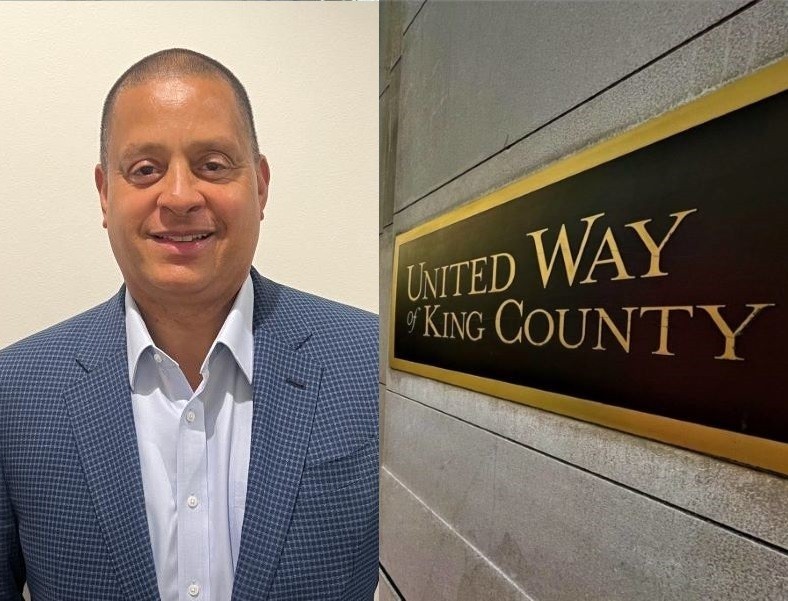
Good news happens. This week’s episode is our monthly commentary and perspective from United Way president and CEO Blair Taylor.
This month, Blair will discuss his take on the state of American education from the perspectives of a parent, an adjunct professor, and the leader of a nonprofit organization. And he’ll also discuss how United Way of King County is working to make quality education affordable and accessible to young people in our county.
We will also discuss an upcoming Happy Hour and Hellos event, and an event sponsored by United Way grantee FEEST.
To listen to the full podcast, search “Hourglass: United Way of King County” wherever you listen to podcasts.
Transcript of Hourglass Episode #136:
Blair Hamilton Taylor 0:00
College still teaches you to be a lifelong learner. It infuses people with that desire and passion to learn. And I got to tell you, I’m still learning. I recognize how powerful that infusion into my heart and soul of trying to learn and really loving learning. What I’ve seen in my own children is a passionate desire to learn more and gain more information, and that is something that we need in our leaders for today and tomorrow.
Joe Burris 0:32
This is Hourglass, the podcast for United Way of King County in Seattle. Coming up, our monthly episode that features commentary and perspective from United Way President and CEO Blair Taylor. For this month, Blair will discuss his take on the state of American education from the perspective of a parent, a teacher, and the leader of a nonprofit organization. He’ll also discuss how United Way of King County is working to make quality education affordable and accessible to young people in our area. We will also discuss an upcoming Happy Hour and Hellos event, and an event sponsored by United Way Grantee, Feest. I’m your host, Joe Burris. Thanks for tuning in.
Joe Burris 1:23
The American education system appears to have a customer satisfaction problem. A September 8th Associated Press article published findings from a Gallup and Walton Family Foundation poll that said just 32% of American adults say they are completely or somewhat satisfied with the U.S. school system, while 67% said they were dissatisfied. Associated Press also cited findings from a separate Gallup and Walton survey that said only two in 10 Americans believe schools are doing a good or excellent job of teaching critical thinking and preparing students for the current workforce. And a September 1 article in the Nation, entitled “The Fifth Estate: What Happened to the American University,” cited Pew Research that said seven in 10 Americans now say U.S. higher education is going in the wrong direction, and at 79% said colleges are doing a fair to poor job of keeping tuition costs affordable. At United Way of King County, we’ve made access to quality education one of the primary pillars of our work, we believe that education is one of the most powerful pathways to economic opportunity, and we believe that that pathway should be accessible to all in our county, particularly those who have historically been on the outskirts of opportunity. We also have a personal stake in the investment and outcomes of our efforts. Chat with mainly United Way of King County staff right now, and you’ll hear stories about the joys and challenges of the start of a new school year, whether our kiddos are engaged in early learning, or adjusting to a new level in grade school, or our young adults are starting or continuing their college experiences, we are proud to offer programs like ParentChild+, which prepares preschoolers for kindergarten with an in-home one-on-one teaching model, and Bridge to Finish, which helps local college students get the services they need to stay in school and complete their education among United Way staff who know firsthand the value and impact of education access, is our new President and CEO Blair Taylor. He is not only the father of college graduates and college attendees, but has served as an Executive-in-Residence and Professor of Practice at Arizona State and as an adjunct professor at his alma mater, UCLA. This week’s episode of Hourglass features Blair’s monthly CEO conversation. For this month, we’ve asked him to offer his take on the current state of American education from the perspective of a parent, a teacher, and the leader of a nonprofit organization. Here’s what Blair had to say.
Blair Hamilton Taylor 4:26
You know, I’m going to start by just zooming out for a second. You know, a college degree in this country was the envy of the world. It wasn’t just for—getting a college degree from one of our universities was what everybody wanted to do around the globe. It was a pathway to higher income. It was a pathway to breaking cycles of intergenerational poverty. And over a lifetime, it helped with employment and employability. And so, it absolutely. And as somebody who—I was an Executive Vice President many, many years ago at what was then the largest college access initiative in the country, called College Summit, which worked to get 1000s and 1000s of low-income students into college who would not have otherwise gone. So I have always been a huge believer in in the value of a college education, and in fact, as you shared, my family’s gone to college. My two parents both went to college, both got master’s degrees as African Americans in the 1950s, which was, you know, very, very rare during that time. So, a college education has been sown into my spirit for quite a long time, and I’ve always been a believer in its value. However, you know, with skyrocketing costs, with the shift to the economy, with things that are going on today, there’s a question—and it’s not an invalid question. I mean, we have to be realistic about this! The question is: Is the college degree still worth it? Is it worth what it was, you know, two or three decades ago in terms of value? And I think a few things have happened in the last two or three decades, Joe, that have called that into question. One, and I, you know, I’m going to be critical of colleges and universities, although I love them to pieces. I’ve been a trustee. As you said, I’ve been an adjunct professor. I’ve worked to help colleges and universities over the last 30 years. But I’m going to be I’m going to be a little critical here. So anybody who’s working with a college or university or has worked with me, bear with me for a minute. Okay, we got to be we got to tell the truth.
Blair Hamilton Taylor 6:38
I think colleges and universities number one focused on hyper growth of facilities in many instances. Spent a lot of time, in a lot of instances, in what I call a sort of nuclear arms race. ‘How can we build the best possible facilities on our campus?’ You know, when I—I’ll just tell a very quick story. When I went to school at Amherst. Down in the basement of my dorm—60 years, 50-60 years before I went to the campus—they hadn’t really changed the facilities. Now, that’s probably not good, but if you go to some of these facilities today, you know they look like the Ritz Carlton.Absolutely, they literally you know they literally have upgraded facilities to such an extent. I’m not just picking on my alma mater. I mean, these colleges and universities spent literally billions of dollars on facilities. The question is, did we spend the same amount on focusing on what should we be training our students to deal with in this century, with the with the massive changes that are going on and have gone on with globalism, with technology, with the the importance of leadership and leadership training, and and I think it’s a question mark, right? So at the same time that that we were doing some of that, we were quite frankly, acting as if, and and this is again a criticism we all have to own, acting as if technology and the advancement of the internet and social media and communications across that medium were a replacement for human interaction. I think I think we lost our focus on interpersonal skills development, on how that is critical to unlocking success. And then you know, last and and certainly not least, I think on a policy level, we stopped focusing in on our funding for public land grant universities, right? And and what and here’s what the implications of that were because it was serious. When you cut off, you know, funding when you say public funding is not going to go in anywhere near the same amounts that it did previously to public land grant universities.
Joe Burris 7:20
Absolutely.
Blair Hamilton Taylor 7:20
They literally have upgraded facilities to such an extent. I’m not just picking on my alma mater. I mean, these colleges and universities spent literally billions of dollars on facilities. The question is, did we spend the same amount on focusing on what should we be training our students to deal with in this century? With the with the massive changes that are going on and have gone on with globalism, with technology, with the importance of leadership and leadership training, and I think it’s a question mark, right? So at the same time that we were doing some of that, we were quite frankly, acting as if, and and this is again a criticism we all have to own, acting as if technology and the advancement of the internet and social media and communications across that medium were a replacement for human interaction. I think we lost our focus on interpersonal skills development, on how that is critical to unlocking success.
Blair Hamilton Taylor 8:31
And then, you know, last and certainly not least, I think on a policy level, we stopped focusing on our funding for public land grant universities, right? And here’s what the implications of that were, because it was serious: When you cut off, you know, funding, when you say public funding is not going to go in anywhere near the same amounts that it did previously to public land grant universities. What that did, is those universities started looking for alternate sources of revenue. And you know where they look? The international community. And they started recruiting really heavily from the international community. Why? Because many of those students were paying full tuition. So that’s how the gap was closed. Now, I’m not against international students, so please don’t take this the wrong way. But what happened with that was, in many instances, those international students would come over to the United States, get a great education in a university, and go back to their home country. Now, what that means is we’re losing domestic talent. So that equation, in terms of investment in the United States and the capacity building of our workforce and the capabilities of our domestic labor pool, were eroding over the last three decades. It’s just what happened. Now, all of that might not have had such a negative effect—it all might not have—if we’d been able to do all that and keep our focus on what made our institutions great in the first place, which was training leaders for the future. That’s what we did. That’s what we did. And human interaction. And critical thinking, the development of critical thinking. So I think we have strayed from the path. I don’t think it’s a problem that we cannot remedy. But we have to be serious and sober about looking at what’s happened.
Joe Burris 10:32
And so, with that, if you were to say what they’re doing well right now, and I remember you and I had a conversation about what the City of Seattle is doing well, what it’s struggling with. Talk a little bit about some of the struggles of higher education, particularly post-secondary. What do you think they’re doing well?
Blair Hamilton Taylor 10:54
Well, I still think they’re attracting the top talent. There’s still there’s still there’s still a pool of top talent that’s coming to these universities, and that’s an opportunity, right? No matter how you cut it. I still think they have a propensity to train critical thinking. They got some great professors. I’m not including myself in that group, by the way, Joe. There are great professors on these campuses across the country, and they have the propensity to train critical thinking, and to help with that—you know, I talked a little bit about the human-to-human side of this—they still have that propensity. But I will tell you after saying that, we need to do a better job on developing the skills that matter in the 21st century. We need to think more carefully about costs, you know, and we need to stay focused on, quite frankly, how do we reinforce America’s talent in a global war for talent? I mean, that’s what we’re in. And so, if we can’t think very soberly about America, America’s talent, America’s labor pool, I think we’re going to face some problems in the next few decades.
Joe Burris 12:16
And now you talked about sort of the importance of college and how much people are really questioning that at this time. And the conversations that you have with people, either parents, fellow educators, students, how many of them are actually questioning the importance of college? And if or when they do, what do you say to them?
Blair Hamilton Taylor 12:42
So, I love that question because I still am a proponent of higher ed. I still think it has tremendous value. I’m going to tell you why. There’s some important reasons. In spite of rising costs, in spite of the things we just talked about in terms of the areas of focus—whether they were fundamentally the soundest possible or not—I cannot imagine a better place to build a powerful network than on the campus of a college or university. And those who are listening who are on colleges and university campuses, I’m telling you, network with every single person you possibly can because your paths will cross throughout your career. And it is a possibility for networking that cannot be replicated. And so, a powerful network. I just had to go in for some some surgery, some orthopedic surgery a few months back, and the way I found my surgeon was I called up a person who was a classmate of mine in undergrad, who also happens to be a physician. He doesn’t happen to do the kind of surgery I needed, but he has to be a physician, an orthopedist, and he recommended something. Wow, that’s what a network is. That’s how powerful that college network is 30, 40, years later, 50 years later, for some people. You’re still drawing from the power of that network. So that’s number one.
Blair Hamilton Taylor 14:17
Number two, college still teaches you to be a lifelong learner. It infuses people with that desire and passion to learn. And there, I got to tell you, I’m still learning. I recognize how powerful that infusion into my heart and soul of trying to learn and really loving learning. What I’ve seen in my own children is a passionate desire to learn more and gain more information. And that is something that we need in our leaders for today and tomorrow. And relatedly, in the last thing, Joe, I got to tell you something. One of the things college does—as you explore and you learn and you grow and you meet all these incredible people—t starts to let you know how much you really don’t know. Okay, you know, there’s some value in that. There is this thing called humility that can take people through a whole lot of would-be crises in their life. So it teaches you how little you really know relative to all the knowledge that’s out there, and that’s a powerful thing. So even if college just does those three things—networking, lifelong learning, teaching you how little you really know and giving you a sense of humility in terms of your place in the world and the universe—those are absolutely invaluable. They’re just tremendously important, I think, for the leaders of tomorrow.
Joe Burris 15:53
Great, great. Now, I think I mentioned to you earlier, Pew Research said that 79% of adults say that colleges are doing a fair to poor job of keeping tuition costs affordable. Again, as someone who teaches at a university, someone who has a child in school, where do you stand on the issue of affordability, and what do you think needs to be done?
Blair Hamilton Taylor 16:29
Yeah. So let me segue into this by way of a story. And by the way, just a minor correction: I had one kid in college and three who have gone through college.
Joe Burris 16:39
Right. Right. Right.
Blair Hamilton Taylor 16:39
So there has been some serious financial (investment), ya know.
Joe Burris 16:45
Exactly.
Blair Hamilton Taylor 16:46
You know, things absorbed through that. And I’m not asking for sympathy on that. I’m just stating a fact. Like families put themselves into serious potential financial jeopardy, in many instances, trying to make sure that their young people go through college. And that’s that’s a real thing. So let me just tell a quick story. So when I when I went to Amherst, you know, way back before electricity, I had a tuition bill of $9,000 for my senior year, approximately $9,000 a year. I paid for that with $3,000 of money that I earned over the summer, doing my summer work, $3,000 approximately contribution from my parents, and $3,000 that was either scholarship or student loans. So kind of a 1/3, 1/3, 1/3. My child goes off to college and will work. They earn approximately the same $3,000 that I earn. Tuition is now $80,000 from college tuition on the board.
Joe Burris 17:50
Wow…
Blair Hamilton Taylor 17:52
So think about that for a minute. Like I could actually, in a meaningful way, contribute to my college education. When a young person comes to their parents now and says, “Can I give you my 3000? The parents are like, “Look, man, it’s 85,00!” I mean, you know, it’s not-it’s not even a blip in terms of what that cost is. So, you know, that is just a true story and a realistic depiction of what has happened, particularly at the top colleges and universities across this country. The costs have skyrocketed way beyond the costs of inflation. So, the second part of your question, you know, I think, was what can be done about it? it’s a significant problem. I don’t pretend to have the answer to that. Okay, I think one of the things might be—just coming back, Joe, to this notion of public policy and where are our prioritiese have to figure out a better way of supporting our public land grant institutions. By the way, that’s not just for the matriculation of students, which is incredibly important and valuable, but it’s also for research purposes. You know, so many of our innovations in this society have come out of college and university campuses.
Blair Hamilton Taylor 19:14
People don’t realize, you know. They think that it’s all coming from the corporate sector, and a lot of it is, but many of the breakthroughs in technology and science have come from research that was conducted in our public universities or even in our private universities, which have received tremendous amounts of public sector support over the previous eras. And we’ve dialed back on that—to our detriment—at a time when the rest of the world has realized the equation that worked for us in the 20th century and is implementing that offense. So, in fact, you couldn’t have a worse scenario when you’re pulling back from what worked and what caused our economy to thrive—in terms of college graduates and campuses that were doing incredible researchnd we’re pulling back from that at a time when the rest of the world is going full throttle into it. So that, to me, is probably the number one thing around costs and cost mitigation. It’s really to try to make sure that we are supporting these institutions. And then yes, we have to think about what our priorities are. We talked about how, you know, the facilities nuclear is race… I’m hoping that that has come to a close. Not to say we don’t need facilities and upgrades to our facilities, but I’m not sure we need the Ritz-Carlton on the campus of the university. I didn’t have it, and quite frankly, I I learned a whole lot in that you know dorm that was there for 50 years, 40 years, 50 years before I came. So that too is an is an important thing.
Joe Burris 20:52
And lastly, we at United Way of King County have worked to make education accessible and affordable from early learning all the way through college—with programs like ParentChild+ (the early learning program), Bridge to Finish, and the Nordstrom Scholarship. Can you talk about how United Way is uniquely positioned to support students from early learning through college?
Blair Hamilton Taylor 21:19
Yeah, Joe, I appreciate I appreciate that question, and and you know it’s not it’s not self serving of us to talk a little bit about the United Way. I don’t think. Because it’s such such an important agency. It isn’t about this; it isn’t about you and me, or anybody who works at the United Way or is fortunate enough to be there. It’s about you know agencies that can make a difference and have the potential and the history of doing exactly that. And so, I’m proud of the United Way’s record, and I’m proud to be a part of this great organization. And I know you are as well.
Blair Hamilton Taylor 21:52
I think the United Way is uniquely positioned now to support college students, not just through some of the programs that you mentioned, but the strengths of this agency, one of the strengths of this agency, is our ability to keep young people on track. You mentioned programs that help young people who are in colleges or in community colleges who run into a major problem. They may have had a car accident.
Joe Burris 22:21
Right.
Blair Hamilton Taylor 22:21
They may have had a medical bill. They may have had some financial issue that arose that will cause them to drop out of school. We intervene at that moment and provide them with the resources to help them through that critical period. So this agency is focused on keeping people on track, helping people to achieve what they might otherwise be derailed from achieving. I think that’s a really important point.
Blair Hamilton Taylor 22:48
The second thing that we do uniquely is we work across agencies and communities. We work across sectors of the economy. What do I mean by that? We work with the public sector, the private sector, the nonprofit sector. We work with lower-income communities and the highest-income communities. What do we do? We try to bring them together to build solutions at scale. Now that is a, you know, unique strength of this agency. And quite frankly, you know, if you look at my background, I think that’s why they put me in this role as a board of directors, because that’s what I have focused on. How do you build coalitions to unlock the collective strength across different disciplines, across different part sectors of the economy, across different sectors of business of the business world or the the nonprofit world, and do that in a way that can help to achieve scale in solutioning. And that’s what we’ve done. and And so we do that by trying to help students who are in education, trying to keep them on track. And I believe that this collaborative approach, this ability to build solutions together, is part of what we’ve gotten a little bit off track of as a society, and that we have to get back on track for us to build the solutions that we need. And I think this agency can.
Joe Burris 24:17
Awesome. Thank you so much, Blair, for your time today on Hourglass. It is always a pleasure. Really appreciate it.
Blair Hamilton Taylor 24:24
Yeah, same here, Joe. Keep doing what you’re doing. Okay, thank you.
Joe Burris 24:29
For more information about United Way’s education work, log on to uwkc.org, click on ‘what we do,’ click on ‘our neighbor fund, ‘and click on ‘educational opportunity.’
Joe Burris 24:44
Join us on October 15 as we celebrate 10 years of community building and impact through our young professional group, Emerging Leaders 365. Old and new friends alike are invited to join all our Emerging Leaders festivities this year, beginning with our Happy Hour and Hellos at Tutta Bella in Seattle on October 15 at 5:30 p.m. You’ll network with like-minded professionals over hearty refreshments and be inspired to take action in the community. For more information, log on to uwkc.org/events.
Joe Burris 25:24
United Way of King County grantee Feest is a Seattle-based organization that trains youth of color and working-class youth to build collective power and organize to bring about change in their schools. On September 19th, Feast is once again hosting Make Food Make Fam, a free community dinner. The meal will be made from scratch and cooked by youth and community members. Feast will also release findings from a community research project led by youth who probed the question, “What is working in South Seattle and what isn’t?’ Feest hopes the findings become a starting point for changes in South Seattle that center on youth empowerment. For more information, log on to Feest’s website at feestseattle.org. That’s f-e-e-s-t-seattle.org.
Joe Burris 26:22
At United Way of King County, we are working side by side with communities to build an equitable future for everyone. “Hourglass: United Way’ is a podcast that highlights how we and our partners spend time making a difference in our communities. Our work is made possible by generous donations from people like you. Please send all comments and suggestions about our podcast to hourglass@uwkc.org. Be sure to follow us on Instagram, Facebook, and LinkedIn via @UnitedWayKC. And to learn more about our work or to support United Way, log on to uwkc.org. I’m your host, Joe Burris. Thanks for listening. Until next time.

Comments