
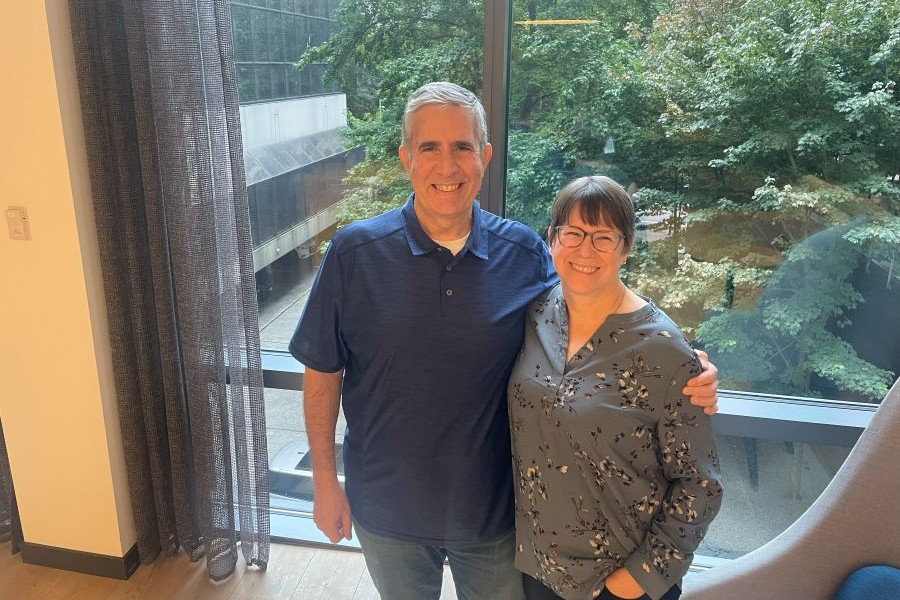
Laura and Ross Comer: Why [We Give to] United Way
Ross and Laura Comer know what it means to be of service both on the job and in the community.
Laura is a retired audiologist who helped people hear better with hearing aids and cochlear implants. Cochlear implants are surgically implanted devices that restore hearing for individuals with more severe hearing loss. And if you’re churning out documents free of spelling errors, thank people like Ross, a retired software engineer and manager at Microsoft, Uber, and Dropbox.
While at Microsoft, Ross started on the Excel 5 development team and led the development of Excel features such as AutoCorrect and AutoComplete.
And the two continue to use their talents and gifts in retirement. Ross, for example, is a licensed pilot who does volunteer work flying patients from across Washington, Oregon, and Idaho for treatment in Seattle. Since Laura retired from Virginia Mason, she has volunteered in a variety of activities, including Community Loaves, providing homemade, nutrient-rich bread to local shelters.
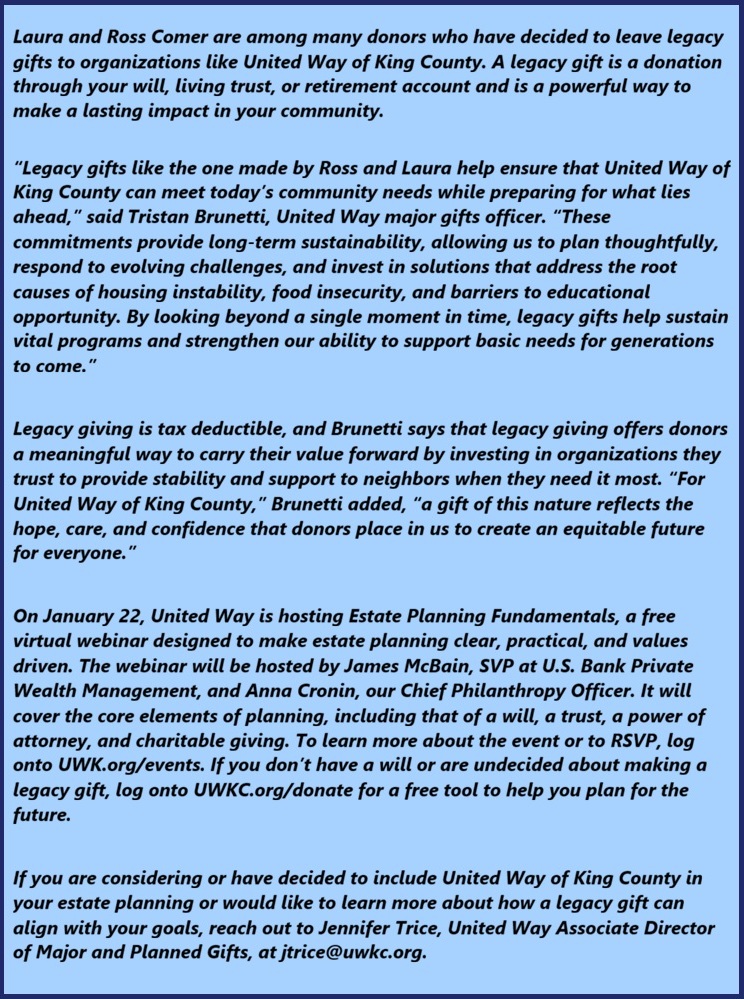
In addition to doing charity work, the couple has been steadfast donors to United Way of King County, particularly around our work that addresses housing and food insecurity. They also recently announced a legacy gift to United Way to ensure that their giving will continue for generations to come.
We sat down with Laura and Ross for a discussion about why they give to United Way as well as their history of giving and their passion to make an impact on causes they care about.
United Way of King County: Ross, you worked at Microsoft when United Way was one of its major fundraising components. What was that like when you arrived at the company?
Ross: When I started in 1992, United Way was the main organizer and recipient for Microsoft’s annual giving campaign. Eventually, Microsoft broadened the focus away from just United Way, but that introduction led to a better understanding of United Way’s impact.
United Way of King County: After Microsoft’s fundraising was established by a separate organization, why did you keep giving to United Way?
Ross: We donate to many charities across a variety of areas, whether it be health care or the arts, but United Way is our main charity for helping our local community. We specifically donate to United Way of King County because we believe in investing in our community, helping those closest to us.
United Way of King County: How do you decide, in giving, what you want to give to within United Way? Or do you say, “We give, and you decide.”
Laura: We trust the experts at United Way to make educated decisions on where that money is most needed and most impactful.
Ross: Exactly, we leave it as a general gift. And that’s true of almost all our donations. We look at the organizations and what they stand for, and how they manage our money.
Laura: We’ve done enough due diligence to be comfortable that the organization is using the money wisely and doing so in an efficient manner so as much as possible goes to those who need it.
United Way of King County: Talk about growing up, and how that led you to this moment, where you sought to give and give back.
Ross: Before college, there wasn’t much money going around so activities I participated in would frequently hold fund-raisers (think car washes). It was heartwarming to be able to raise money to help less-fortunate students join in those activities that they otherwise wouldn’t be able to afford. I went to Carnegie Mellon University, where I joined a service fraternity called Alpha Phi Omega, a national service organization. At Alpha Phi Omega, we served the campus and community through volunteerism and fundraising. We ran projects that would help students, such as providing inexpensive buses to take students home during the holidays, while still generating money that we would donate to local charities. Fun fact: Carnegie Mellon is in Pittsburgh and is near “Mr. Roger’s Neighborhood”, just a few blocks from the studios that produced the show. That PBS station was often a recipient of our time and money.
Laura: I grew up in Bothell in a middle-class family, four kids, with not a lot of spare cash at all. But my parents provided great examples of volunteering in the activities we were involved in. It wasn’t until Ross and I had dual incomes and were encouraged by Microsoft in the Annual Giving campaign that we made annual giving a tradition.
United Way of King County: What was it like to take on giving as a thing you do today?
Laura: We were happy to contribute what little we could in our early careers. But as our careers progressed and we had more discretionary funds available, it’s been a privilege to be able to give to those organizations that we believe in.
Ross: I completely agree with Laura. I am proud of what we’ve been able to donate over the years. But more importantly, we are thrilled with how our children have made charitable giving an important part of their lives. It is great to see their appreciation when we allocate them money from our Donor Advised Fund that they can then direct to the charities that are most meaningful to them. It’s through that excitement that we know that they will continue our legacy of giving.
United Way of King County: Where do you look to see the impact of your giving?
Laura: I’ve lived in the Seattle area since third grade and worked downtown from my early 20s. We both see the homeless population as a growing problem. And it’s vastly different from what I recall. Ross, when he retired, said, “I’d love to see every person in Seattle have some sort of roof over their head so that they’re not on the street in the cold and elements.”
Ross: Exactly. I think it’s ludicrous that in today’s society, there are people on the streets, no matter what the circumstances, be it job instability, mental health, or drug problems. That’s my long-term charitable focus. I’ve gotten some great pointers from United Way and look forward to learning more and contributing not just money but my time as well. I believe Seattle, King County, and Washington have the money and willpower to solve problems like this.
In choosing where else to give, we look around for things that are important to us. We are frequent attendees of the arts and support several local organizations. Laura, having worked in health care, has brought us to several different charities focused on solving medical issues. We also contribute to various human services and public benefit charities. The question for donors is what areas are important to them, what services support those areas, and how to build trust to know which organizations are going to best utilize their donations.
There are many resources available to help you understand how charities are using their money, as well as talking with the organizations themselves and getting involved with some of their activities. That’s how we decide to invest. And United Way has certainly earned our trust and respect to justify a legacy gift.
Comments
Hertha Zboncak
January 22, 2026Your blog is a breath of fresh air in the often mundane world of online content. Your unique perspective and engaging writing style never fail to leave a lasting impression. Thank you for sharing your insights with us.